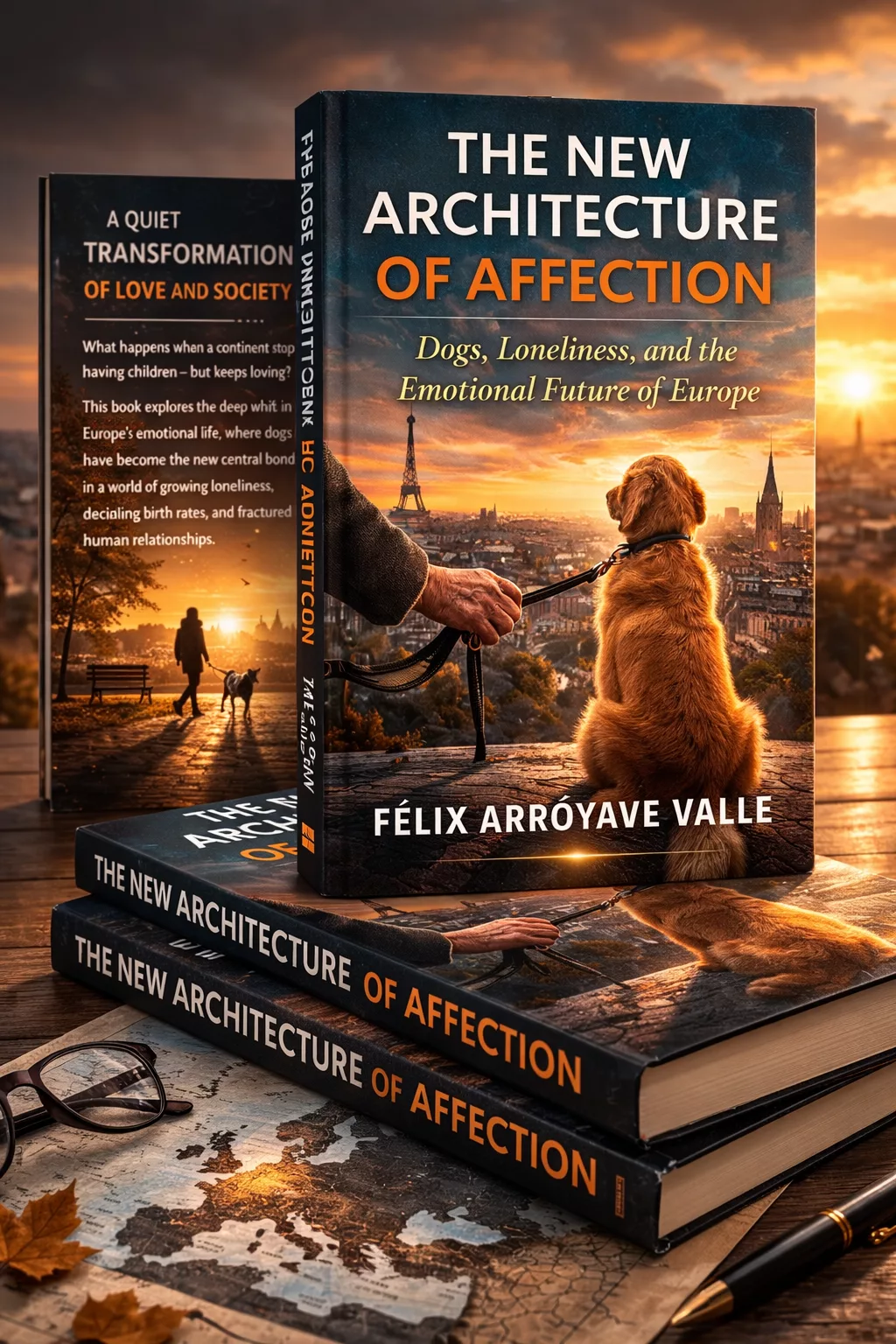
The New Architecture of Affection explores this silent but profound shift.
Europe is not only undergoing a demographic crisis.
It is undergoing an emotional transformation.
Over the past decades, birth rates have declined, populations have aged, households have shrunk, and long-term human relationships have become more fragile. At the same time, dogs have moved from the margins of domestic life to its emotional center.
This book is not about dogs as pets. It is about what their growing centrality reveals about modern European societies: how affection is redistributed when traditional family structures weaken, how companionship adapts to urban solitude, and how emotional needs are reorganized in an era of individual autonomy, demographic decline, and digital identity.
Drawing on demographic data, sociological analysis, and everyday urban observation, Félix Arróyave Valle examines why millions of Europeans now structure their daily routines, emotional investments, and even long-term planning around a companion animal. The dog, in this context, is not a cause of demographic change—but a compatible response to it.
The book analyzes:
- The relationship between declining fertility and the rise of companion animals
- The reduced household and the intensification of emotional bonds
- Aging, loneliness, and the dog as a regulator of emotional stability
- The growth of a permanent care industry around pets
- The dog as identity, symbol, and emotional refuge
- The limits of the bond: conflict avoidance, abandonment, and ethical tension
- A projection of what European cities may look like by 2035
Rather than offering moral judgments, this essay asks a deeper question:
What happens when the most stable bond in millions of households is with a being that does not confront, does not demand negotiation, and offers unconditional validation?
The New Architecture of Affection does not argue against loving dogs. That love is real, legitimate, and deeply human. What it questions is the broader emotional landscape in which that love has become central.
Is this shift a healthy adaptation to modern life—or a displacement of more demanding human bonds?
Is it conscious choice—or cultural inertia?
Is affection being complemented—or quietly reallocated?
Written in a clear, reflective, and accessible style, this book invites readers to look at familiar scenes—morning dog walks, pet-friendly cities, childless households, aging populations—and see them as part of a larger structural transformation.
This is a book for readers interested in:
- Sociology and cultural analysis
- Demographic change in Europe
- Modern intimacy and loneliness
- The future of family and care
- The emotional consequences of urban life
The New Architecture of Affection does not offer verdicts.
It offers a mirror.
Because what a society chooses to love reveals the kind of future it is building.
You can see the Spanish version at the following link La nueva arquitectura del afecto –
Enjoy it:
Amazon.com: The New Architecture of Affection: 9798249426057: Arróyave Valle, Félix: Libros
Deja una respuesta